Why The 2026 FIFA World Cup Will Be Ronaldo's Last
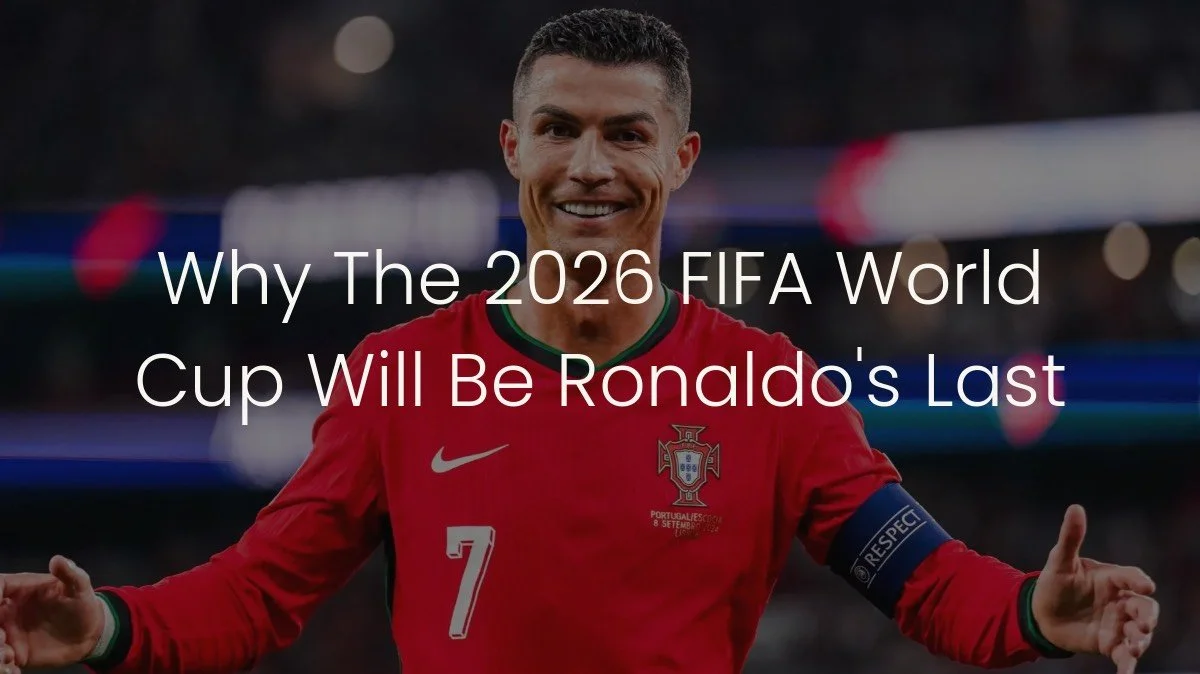
At the age of 40, Portugal captain Cristiano Ronaldo has confirmed that the 2026 FIFA World Cup will be his last. In a video appearance at the Tourism Summit in Riyadh, Ronaldo stated plainly, “Definitely, yes… I will be 41 years old and I think [this] will be the moment in the big competition.”
This decision—coming from one of the greatest, most enduring footballers of all time—deserves a full retrospective. Here we trace Ronaldo’s Portugal legacy, his World Cup journey so far, and how his 2026 farewell will shape the final chapter of an extraordinary career.
1. A Legacy of Records and Leadership
Since making his international debut for Portugal national team on 20 August 2003 as an 18-year-old substitute against Kazakhstan, Ronaldo has become synonymous with Portuguese football.
Some of the landmark achievements:
Over 140 international goals, making him the all-time men’s international top scorer.
More than 200 caps for his country—setting records for appearances among male international players.
Captain of Portugal during its golden era—including the 2016 European Championship triumph and two Nations League titles (2019 & 2025).
His influence stretches beyond just goals and numbers: Ronaldo’s hunger, professionalism and goal-scoring consistency have lifted Portugal’s status from a strong side to a major title-winning nation.
2. Ronaldo’s World Cup Journey—Five Tournaments In, One Final Bow to Go
While Ronaldo has collected nearly every major club trophy, and continental triumphs with Portugal, the FIFA World Cup has eluded him. His journey through each edition tells a story not just of longevity, but of resilience and adaptation.
2006 (Germany)
Ronaldo played in his first World Cup at age 21. Portugal reached the semi-finals, eventually losing to France. He became Portugal’s youngest ever World Cup goalscorer.
It was a coming-of-age tournament. He showed flashes of brilliance, yet also endured criticism for his maturity and style.
2010 (South Africa) & 2014 (Brazil)
These editions were less memorable for Portugal in terms of deep runs. Ronaldo shouldered enormous expectations, but the team failed to break through the quarter-final barrier.
Nevertheless, he continued breaking records—especially his tally of goals and international appearances.
2018 (Russia)
This was arguably his most personally productive World Cup: Ronaldo scored four goals, including a stunning hat-trick against Spain (3-3 draw). Portugal reached the Round of 16 but were eliminated by Uruguay.
While Portugal didn't win it, Ronaldo showed he could still sparkle on the biggest stage.
2022 (Qatar)
At 37, Ronaldo became the first male footballer to score at five different World Cups. He entered the tournament with enormous global attention. Portugal advanced to the quarter-finals but lost to Morocco in a shock exit.
This tournament left many believing his final World Cup could be next.
2026 (USA, Canada, Mexico)
With his confirmation that this will be his last World Cup, Ronaldo embarks on what would be his sixth tournament—an unprecedented feat for the men’s game.
For Portugal, there is still the task of qualification—and for Ronaldo, one final shot at the ultimate prize.
3. Why 2026? Why Now?
In his words:
“Definitely, yes. I will be 41 years old and I think [this] will be the moment in the big competition.” CBS Sports+1
Several factors make this decision logical:
Age & Longevity: Few footballers play competitive international football into their 40s; Ronaldo has extended his prime by maintaining fitness and motivation at elite level.
Physical Load: At 40, each additional year carries increased risk of injury and recovery difficulties—something Ronaldo has repeatedly out-worked.
Legacy Timing: Leaving after the 2026 World Cup gives him a final global stage and full closure at the highest level—a suitable send-off.
Club Priorities: Playing for Al‑Nassr in Saudi Arabia, Ronaldo signed a contract extension in 2025 that still keeps him in top-flight club football. But the focus may shift from international tournaments to club legacy and personal milestones (such as the 1,000-goal quest).
Portugal’s Path: Portugal remain in a transitional phase—Ronaldo’s decision gives clarity to the squad, coaching staff and federation about the timing of a generational shift.
In short: the 2026 World Cup gives Ronaldo one final stage to chase the missing piece in his trophy cabinet—World Cup glory—and then close the door.
4. What Ronaldo Brought to Portugal
a) Goal-scoring machine
Ronaldo’s goals tell a unique story. He has scored across decades, across tactics, club systems and age curves. He became the first male footballer to surpass 140 international goals, and throughout his career he has scored at every major tournament and almost every big moment.
His goals have frequently come in “big moments”:
Clutch qualifiers for Portugal to reach major tournaments.
Knock-out goals in major competitions (e.g., Nations League, Euros).
Milestone goals (first to 200 appearances, first to 140 goals).
b) Leadership and aspiration
Ronaldo’s presence elevated Portugal’s standards. He set the tone for professionalism, training intensity, and the hunger to win continental and global trophies.
When Portugal won UEFA Euro 2016—it was in no small part due to Ronaldo’s inspiration and influence. Although he left the final injured, his leadership all tournament had already stamped his imprint on that historic squad.
c) Tournament experience & adaptability
Over 20+ years, Ronaldo moved from a lightning winger to one of the world’s most accomplished finishers. His ability to adapt—his speed, aerial ability, shot power and discipline—meant he sustained world-class performance when many players fade.
He has played under multiple coaches, tactical systems and in different clubs across countries—bringing his wealth of experience back into the national team.
d) Raising Portugal’s global stature
With Ronaldo, Portugal transformed from a strong European nation to a consistent global contender. Their trophy cabinet reflects this shift: Euro 2016, UEFA Nations League (2019, 2025) and an increasingly respected presence in World Cups.
Portugal’s national team is now seen as one of the world’s elite—not just due to Ronaldo’s talent, but because of what he helped build.
5. What It Will Take in 2026
If 2026 is to mark Ronaldo’s final World Cup, certain elements will shape how that tournament is viewed:
🎯 Full squad support & qualification
First, Portugal must qualify—and maintain a competitive, high-performing squad around Ronaldo. A final World Cup farewell with a deep run would cement the legacy.
🏅 The trophy chase
Ronaldo’s only missing major international prize is the World Cup. Winning it would complete what many see as the “grand slam” of international football (Euro + Nations League + World Cup).
His closing statement suggests he sees 2026 as that moment.
⏳ Good physical condition
At 41, fatigue, injuries and recovery will matter more. Ronaldo’s ability to manage load, rest, and adapt his playing style will be tested. He’s proved extraordinarily durable, but the stage will demand the highest standards.
🌍 A global send-off
As one of the most famous athletes in the world, Ronaldo’s final World Cup will be a global spectacle. The narrative of a GOAT (greatest of all time) finishing his journey will add huge emotional weight—especially if Portugal go far.
🔮 Generational transition
Portugal will need to balance honoring Ronaldo’s final run while preparing for the post-Ronaldo era. Success will depend not just on him, but on the team built around him—young stars, tactical evolution, and team cohesion.
6. Why It Matters — Beyond Ronaldo
This announcement isn’t just about one player: it carries implications for football, for Portugal and for global sport.
Milestone in men’s international football: Few players have competed at six World Cups; Ronaldo’s participation would set a new benchmark for longevity. VnExpress Intl.
Inspirational arc: For young players in Portugal and beyond, his career trajectory—from Madeira to global legend—is a blueprint in ambition, resilience and evolution.
Portugal’s footballing identity: His final chapter brings Portugal full circle—from emerging contender to established power—and allows the federation to articulate a future with or without him.
Sporting legacy culture: As football increasingly emphasizes legacy and player brands, Ronaldo’s decision underscores how elite players think about the endgame—how to exit on their terms, when they still have agency.
7. Reflections and What to Watch
As we look forward to the 2026 World Cup—and to Ronaldo’s final act—here are some key themes to follow:
Will Portugal build a squad capable of deep tournament success? The performance around Ronaldo will matter as much as his personal form.
How will Ronaldo manage his role? Will he play fewer minutes, make substitute appearances, focus on key moments rather than full matches?
What will the narrative be? Will the story be “Ronaldo wins World Cup and retires” or “Ronaldo retires after final bow, no trophy”? Both carry weight, but one frames the legacy differently.
What happens after? Portugal’s transition strategy post-Ronaldo will shape the national team’s next decade.
How will Ronaldo shape his club legacy? Though this covers the national team, his club goals (including the pursuit of 1,000 career goals) will also factor into how he frames retirement. ESPN.com
8. Final Thoughts
Cristiano Ronaldo’s announcement that the 2026 World Cup will be his final appearance for Portugal is more than a retirement notice—it’s the closing of a chapter on one of football’s most storied careers.
From a raw-talented winger in Madeira to global icon, he redefined longevity, goal-scoring and leadership at the highest levels. He transformed Portugal’s national team and left a mark that will last long after he hangs up the boots.
If he walks onto a World Cup pitch for the last time in 2026, he will carry with him not just his own legacy—but the hopes of a nation and the full weight of football history. And if Portugal lift the trophy, his story will reach almost mythical status.
But even if the trophy eludes him, the journey—from debut in 2003 to final bow in 2026—is one for the ages. One of the greatest careers in the sport ends not with a whisper, but with the roar of the crowd, the flashbulbs, and the final “Siuuu!” echoing across the field.
For now, we wait. We watch. We prepare for the final chapter of CR7.